· 4 min read
Travertine coffee table: how to choose one without falling for the cliché (the holes are the point)
By Alexis Grimaud
Travertine coffee tables are everywhere right now, and that is exactly the problem. The same pale slab on the same four blocks, photographed in the same beige living room, until the stone stops saying anything at all. The stone is not the cliché. The lazy shape is.
Our opinion, up front: buy a travertine coffee table for its form or its history, never for the material alone. Here is how to tell the difference before it is delivered, and before two people have to carry it up the stairs.
First, know what you are buying
Travertine is a limestone deposited around mineral springs, and its pores are its signature. Our guide to luxury furniture materials covers the geology and the Colosseum. Here we stay at coffee-table height.
Four questions decide almost everything: which colour, which cut, filled or open pores, and which finish. A seller who cannot answer all four is selling you a photograph.
Colour: beige is the default, not the only option
Most travertine is beige or cream, but the stone also comes in copper red, blue-grey and brown, depending on its mineral content. Quarries sell it under names like Noce, Argento or Navona, and each one reads differently in daylight.
Light beige is calm and forgiving. Red and brown travertines are warmer and more assertive. If your floor is already pale oak and your sofa is already bouclé, a cream slab will not add anything except weight.
Cut: lines or clouds
The same block gives two very different tables depending on how it is sliced. Vein cut shows the stone's bands as parallel lines, a linear, almost striped surface. Cross cut produces a cloudier, more rounded pattern.
- Vein cut suits long rectangles: the lines underline the length.
- Cross cut suits round and oval tops, where stripes would look like they were heading somewhere without you.
Whatever the cut, ask for a photo of the actual slab rather than the catalogue shot. No two blocks are alike, and the one in the picture may not be yours.
Filled or open pores: the real decision
Pores can be filled at the workshop with mastic or transparent resin, or left open. Filled travertine is easier to live with: a smoother top, with nowhere for crumbs or water to settle. Open pores are more textured and more honest, and they ask for a sealant and a little tolerance.
Neither is wrong. What is wrong is not knowing which one you bought, then finding out with a glass of red wine. Travertine is a limestone, so acids such as wine, lemon or aggressive cleaners attack it: coasters stay.
Finish: honed, polished, or close to raw
The classic finishes are polished and honed. Polished is glossy and catches the light; honed is matte and soft to the touch. Our view: on a surface that meets glasses every evening, matte forgives more.
Some designers go further and leave the stone close to its natural state. On the Monolith Collection's M_012 coffee table, the pores stay open and the surface unpolished. That is a decision, not an oversight.
Six tables that avoid the cliché
Three contemporary, three vintage, each with a reason to exist beyond "it's travertine".
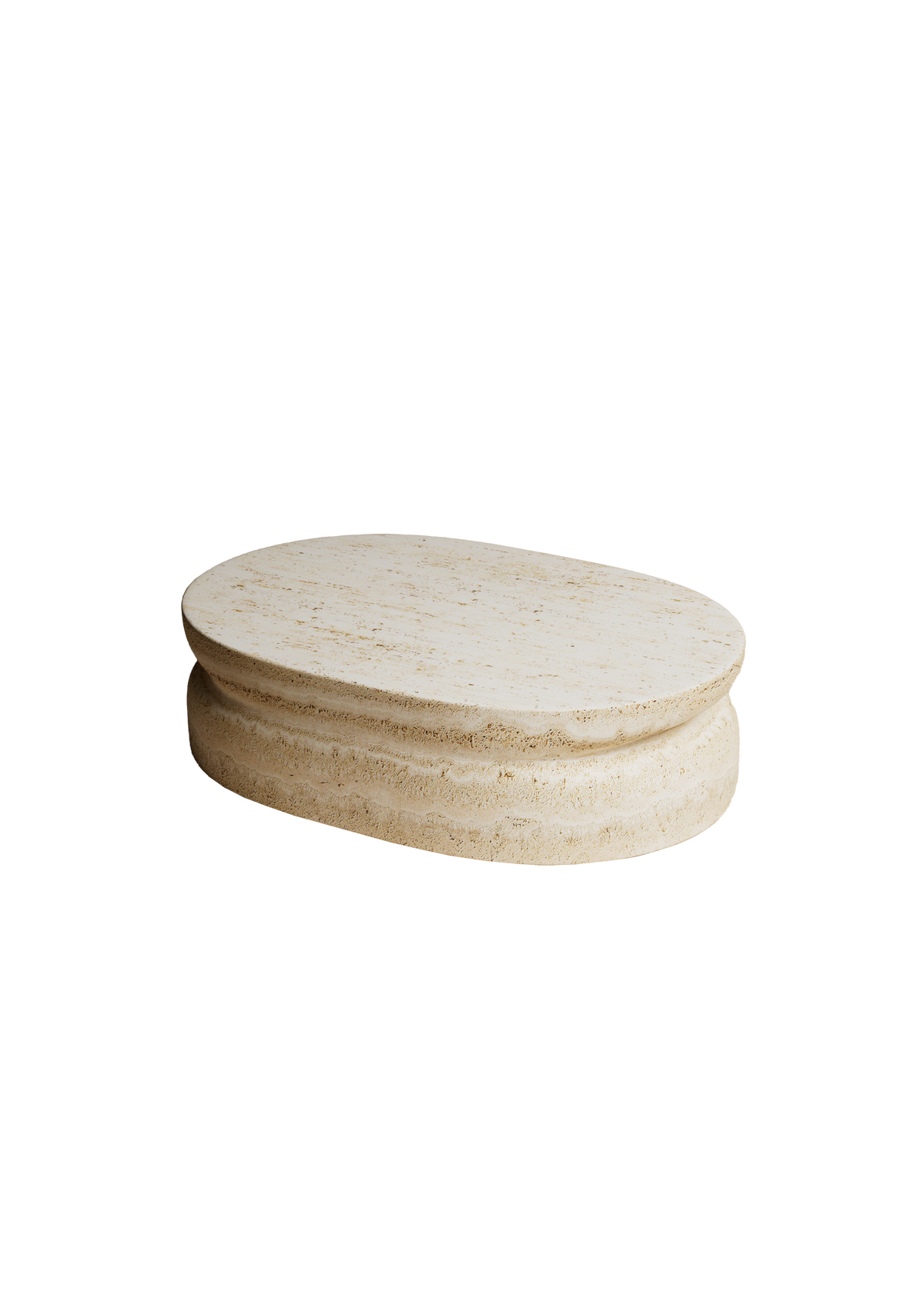
- Nubo Oval Coffee Table, Mathieu Delacroix. Created for Monde Singulier. Two tiers of light beige travertine: a flat top over a thicker base whose profile curves inward. Around €28,600, and the oval plan is the whole argument.
- Salvante C1 Coffee Table, Piotr Dabrowa. Also created for Monde Singulier. A travertine disc on an asymmetric base, a stone column on one side and a stack of flat slabs on the other, with an onyx inlay set flush in the top. Around €22,600.
- M_012 Coffee Table, Monolith. Cut from a single slab, with gently rounded ends and four thick block legs and no visible joinery. Around €15,900, for anyone who wants the four-blocks idea done properly.
- Michel Kin for Arflex, elliptical coffee table, 1960. In The Vestige: a first edition with an Italian travertine top on a stamped brass pedestal, fully restored. €9,500. Travertine long before it was a hashtag.
- Philippe Barbier coffee table, 1970s. The clever inversion: tiered thick glass slabs resting on travertine feet. €4,500. Here the stone holds the table up instead of showing off on top.
- Italian coffee table, 1970s. Sienna yellow marble with travertine, for those who find one stone a little shy. €5,800.
Prices shown on the site including VAT, November 2026.
Before you order: the practical part
- Weight. A stone table is heavy, and a two-tier oval is heavier than it looks. Check the floor, the lift and the staircase before the delivery date, not on it.
- Edges. Look at the profile, not just the top. On a low table, the edge is what your shins and your guests meet first.
- Dimensions. Contemporary pieces made to order can often have their dimensions or finish adapted with the designer. Ask before production starts.
- Care. A damp cloth, a detergent made for natural stone, a protective treatment from time to time. For a sixty-year-old top, read how to care for vintage furniture before you reach for a sponge.
Our verdict
A travertine coffee table is worth it when its shape would still be interesting in wood. If it would not, the stone is doing all the work, and you are paying for a trend by the kilo.
New to all this? Our guide on how to buy collectible design covers the rest of the checklist. Then compare every designer coffee table in the catalogue, or go straight to the vintage coffee tables of The Vestige.
See the stone before you live with it
A screen flattens stone more than any other material: the pores, the colour shifts, the weight. Book a visit to the Paris showroom on rue de Rivoli, facing the Tuileries, by appointment, and talk colour, cut and dimensions with an advisor in front of real pieces.
The pieces we mention


A piece on your mind?
Prices, lead times, finishes: an advisor answers you personally.