· 4 min read
Sculptural lamp: stop buying lamps, buy light (the switch-off test comes first)
By Alexis Grimaud
Most people choose a lamp the way they choose a vase: by looking at it. That is how you end up with a beautiful object that turns the living room into a waiting room at 9 pm.
Our view is simple. A sculptural lamp has to pass two tests: worth looking at switched off, at noon, and worth living with switched on, at night. Fail one and you have bought an ornament with a cable.
Judge it twice: at noon and at 10 pm
In daylight a lamp is furniture. It has a silhouette, a material, a weight on the floor, and it stands there for twelve hours doing nothing but being looked at.
After dark it becomes the opposite: a source. What matters then is where the light goes (up, down, through, around), how soft it is, and whether it flatters skin and materials or flattens them.
The pieces worth buying do both jobs well. That is why we would rather talk about light than about lamps: the object is the bottle, the light is the wine.
Three families of light (and the lamps that make them)
Almost every sculptural lamp belongs to one of three families. Knowing which one you are buying prevents most disappointments.
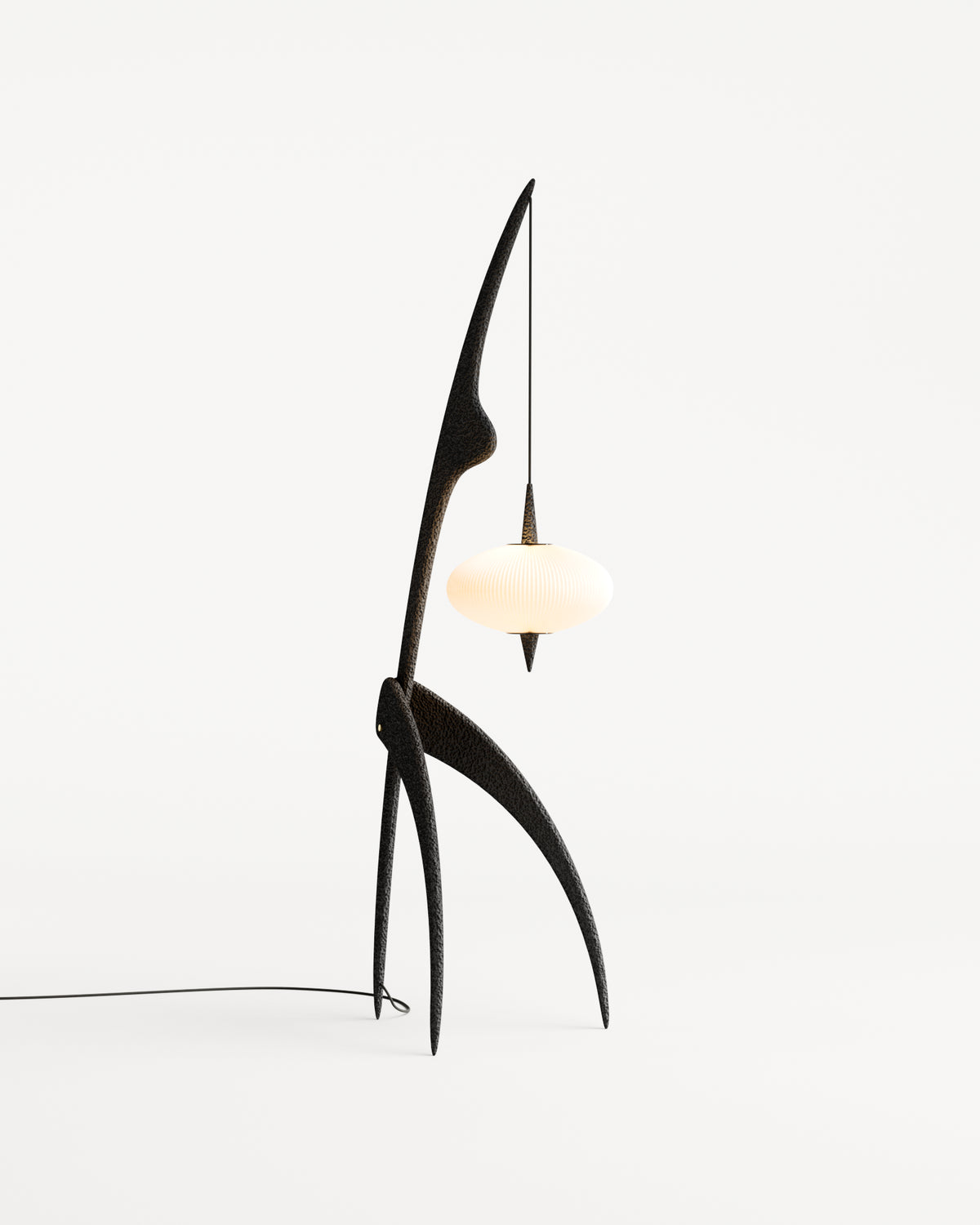
- Light through a material. Pleated shade, paper, opaline glass: the bulb disappears and the whole shade glows. Soft, general, flattering. This is the family of La Mante Religieuse, the floor lamp Rispal and sculptor Lucas Castex produced for Monde Singulier, with a hand-carved dark wood base and a pleated off-white shade.
- Light bounced off a surface. Petals, reflectors, a flat top that throws light at the ceiling. Olivier Mourgue's 2093-150 sends its light onto white petals, and Garance Vallée's 2093 floor lamp washes the ceiling from above. Indirect, architectural, very kind to a room with good mouldings.
- Light held in the material. Glaze, crackle, stone: the diffuser itself becomes the subject. Johanna de Clisson's Stellar Éros, a unique wall lamp, sets a cracked-enamel ceramic globe under a walnut backplate, and the crackle catches the glow and keeps it.
The trick is to mix families in one room. One glowing shade, one indirect source, one jewel on the wall: the room gets depth instead of a single flat wash.
Lamps that refused to be lamps: a short history
The idea is not new. In 1951, on a trip to Gifu, a Japanese town known for its paper lanterns, Isamu Noguchi designed the first of his Akari lamps and insisted on calling them light sculptures. They are still made there by hand, in washi paper and bamboo.
France had its own version the same decade. Maison Rispal's Mante Religieuse floor lamp dates from the 1950s, and it was antique dealers and decorators who gave it its nickname, because the slanted wooden legs and hanging shade looked like the insect.
In 1967 Olivier Mourgue designed the 2093 lamps, aluminium petals on chromed metal, first produced by Disderot, which reissues them today. In 1972 Michel Mortier drew the 10497 table lamp, an aluminium base under an opaline glass shade, originally published by Verre Lumière.
For the other great French chapter, our portrait of Serge Mouille, the man who turned light into sculpture, picks up the story.
Six we would put in a room tomorrow
- La Mante Religieuse, Rispal x Lucas Castex, around €6,700. The figure in the corner, the one guests ask about. A limited edition made for Monde Singulier.
- Michel Mortier Table Lamp 10497, Disderot, around €3,300. The 1972 design in an edition made for Monde Singulier, with a colour gradient running from the shade down to the base. Numbered, with a certificate of authenticity.
- Olivier Mourgue 2093-150, Disderot, around €3,000. Two flower heads stacked on a chrome stem: Space Age without the costume.
- Stellata floor lamp, François Bazin, around €4,900. A ribbed textile shade echoing a magnolia blossom, on a champagne steel stem and a concrete base.
- 2093 floor lamp, Garance Vallée, around €9,000. A unique piece in brushed metal that lights the ceiling rather than your eyes.
- Stellar Éros, Johanna de Clisson, around €2,900. A unique wall lamp, for the wall that needed something and could not take a painting.
Prices shown on the site including VAT, November 2026.
Where it goes (and where it does not)
A sculptural floor lamp needs air around it. Pushed into a corner behind a sofa, it becomes a pole wearing a hat.
Indirect lamps need a ceiling worth lighting: pale, not too high, ideally with some relief. Lamps that glow through a shade work almost anywhere, which makes them the safest first purchase.
A table lamp sits at eye level when you are seated, so judge it from the sofa, not from the doorway. And one rule for the whole room: several low points of light beat one strong one in the middle of the ceiling.
Four questions before you buy
- What does it look like off? Look at it in daylight and ask whether you would keep it unplugged.
- Where does the light go? Up, down, through or around. If the description does not say, ask.
- Can it be dimmed? Some editions offer a dimmer as an option, and a sculptural lamp at full power is rarely at its best.
- What exactly is the edition? Unique piece, numbered series, reissue: three different purchases. Our guide to limited editions, unique pieces and prototypes explains what the paperwork should say.
For the material side of the question (opaline, ceramic, brushed metal, wood), our guide to collectible design materials covers how each one lives and ages.
See the light before you buy it
Photos are good at silhouettes and bad at light. The honest way to choose is to see a lamp lit, next to real wood, stone and fabric.
Start with the lighting collection, then book a visit to the Rivoli showroom in Paris, opposite the Tuileries, by appointment. Bring your floor plan and the one question a photo cannot answer.
The pieces we mention


A piece on your mind?
Prices, lead times, finishes: an advisor answers you personally.