· 5 min read
Luxury furniture materials: travertine, lacquer, burl and pewter (and how not to fall for the wrong one)
By Maxime
Ask ten dealers what makes a piece collectible and you will get ten speeches about vision. Ask what it is made of and you get the useful answer. The material decides how a piece ages, what it weighs, how it catches the light and what you will be explaining to your housekeeper in five years.
So here is our opinion, up front: in luxury furniture, the material is not the finish. It is the design. Four materials do most of the heavy lifting in our catalogue right now: travertine, lacquer, burl and pewter. Here is how to read each one, and how to live with it.
Travertine: the stone that looks better with holes
Travertine is a limestone deposited by mineral springs. Groundwater loaded with carbon dioxide dissolves limestone underground, releases the gas when it reaches the surface, and calcium carbonate settles layer after layer. The name comes from lapis tiburtinus, the stone of Tibur, today Tivoli, near Rome.
Its references are hard to argue with: the Colosseum is the largest building in the world constructed mostly of travertine. The porosity gives the stone its pitted, honeyed surface and makes it lighter and easier to work than you would think. It is also the thing you have to manage.
- Seal it. Unsealed travertine drinks whatever you spill. A sealed surface handles everyday life.
- Watch the acids. Wine, lemon and aggressive cleaners attack limestone. Coasters are not optional, they are a philosophy.
- Ask about the holes. Some surfaces are filled, some are left open. Neither is wrong, but you should know which one you are buying.
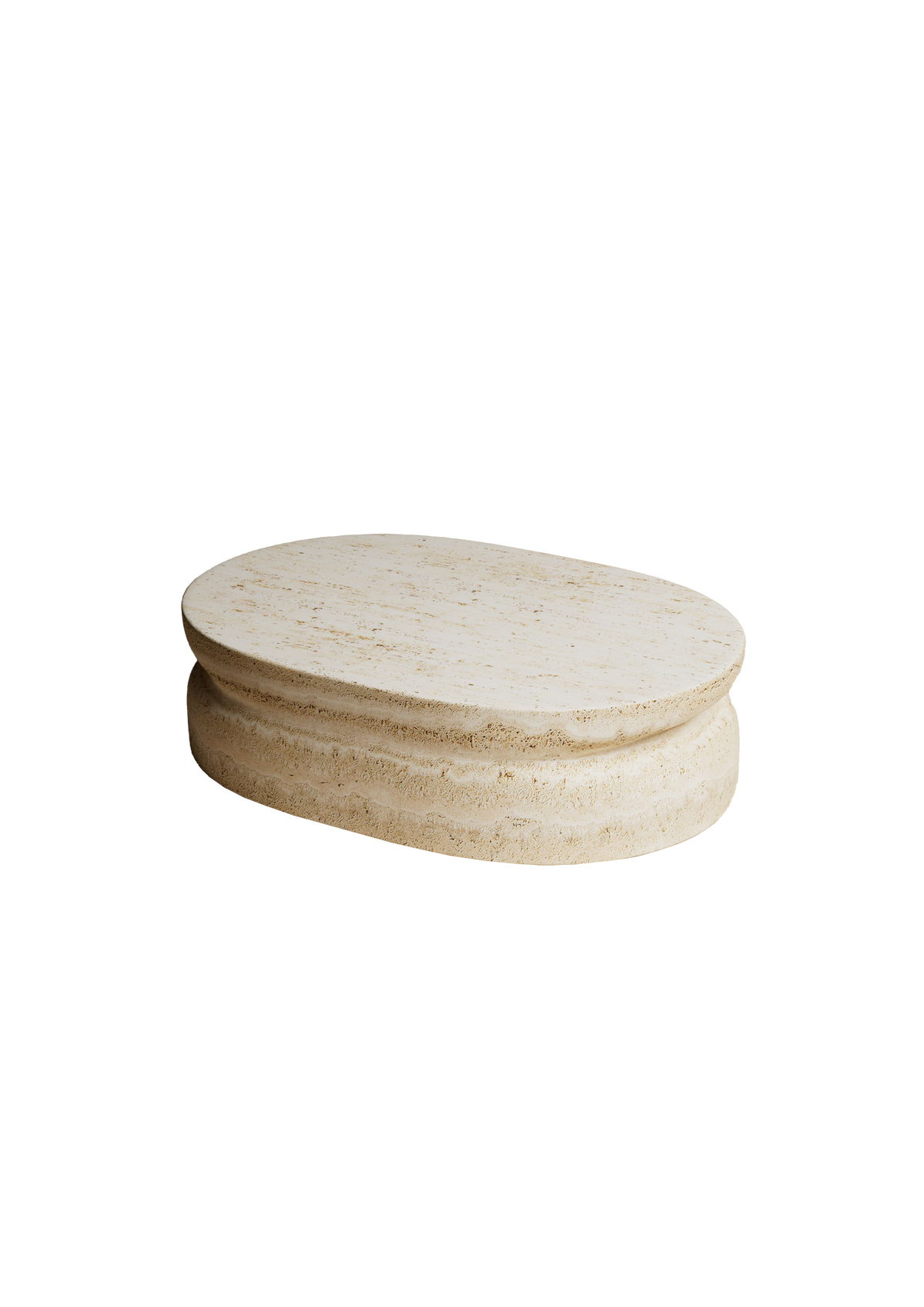
Two ways in. Contemporary: the Nubo oval coffee table by Mathieu Delacroix, two tiers of light beige travertine with the stone's markings left intact, around €28,600. Vintage: an elliptical coffee table by Michel Kin for Arflex, a first edition from 1960 with a travertine top on a brass pedestal, €9,500 in The Vestige. Same stone, sixty years apart, and both still hold a room.
Lacquer: the slowest shine in the house
Traditional Japanese lacquer, urushi, is a tree sap. It goes on in thin layers, each one sanded once dry, and a single layer can take five or six days to dry. Paris learned it largely from one man: Seizo Sugawara, a Japanese artist who taught Eileen Gray and, in 1912, gave Jean Dunand 13 lessons over two months.
Dunand then turned lacquer into one of the signatures of Art Deco. Today, do not assume every glossy surface is urushi: ask which lacquer was used and how many coats. What you are really paying for is the preparation underneath, because a lacquer is only ever as flat as the surface it covers.
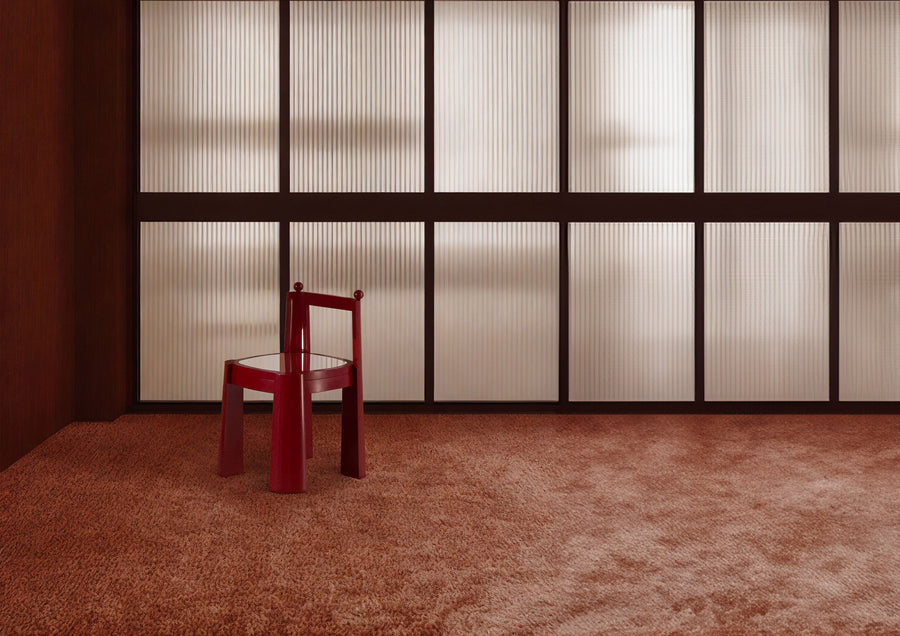
Our current favourite: the 1976 collection by Nouveau Standard, in lacquered beech veneer with spheres or half-spheres of solid lacquered beech, colour of your choice. The Chaise 1976, with its Casamance velvet seat, is around €4,500. Fair warning: in red, nobody will mention your kitchen again.
Living with it is simple. A soft dry cloth, no abrasive sponge, no hot dish straight on the surface. Gloss shows fingerprints, satin forgives them: choose according to who lives with you, not according to the photo.
Burl: the wood that looks like a painting
A burl (burr, in British English) is a deformed growth on a tree, usually a rounded outgrowth packed with small knots from dormant buds. It is often triggered by stress: an injury, a virus, a fungus. The result is a twisted, interlocked grain that is hard to work, rare, and impossible to repeat.
That is exactly the point. Two pieces cut from burl are never identical, so the photo on the site is a portrait, not a contract. Burls are commonly sliced into veneer, which is how a figure that wild ends up on a clean, geometric form.
Exhibit A: the Ert club armchair by Studioutte, created for Monde Singulier. Seven wooden boards, a strict Dutch Neoplasticist geometry, a glossy blonde burl and an ivory Dedar velvet cushion, around €7,600. The grain does the talking, the structure keeps it polite.
Pewter: the metal nobody expected in the living room
Pewter is mostly tin, roughly 85 to 99 percent, with antimony, copper and bismuth. Older pewter often contained lead; most modern pewter is lead-free. For centuries it was the material of plates, cups and tankards across Europe, until porcelain, pottery and glass pushed it off the table in the 18th and 19th centuries.
Studioutte brought it back as furniture. In the Soft Solid collection, wooden structures are encased in a full pewter coating. The Malta stool, around €9,600, shifts from warm grey to cool silver with the light, and the Ert club armchair in pewter, around €16,100, is the same seven-board chair as the burl version with the grain silenced by metal.
Why choose it: a soft, slightly matte gleam that brass and chrome never quite manage. Why hesitate: pewter is a soft metal, so it records your life. If you want a surface that stays factory-fresh forever, buy a photograph of one.
Prices shown on the site including VAT, November 2026.
And bronze, resin and the rest?
They matter too, and the classic rules still apply. Bronze darkens and gains depth as it oxidises: the patina is a feature, and the finish specified by the foundry is part of the work. With resin, ask which formulation was used and whether it is UV-stabilised, because that is what decides whether it yellows.
How to choose: four questions, not forty
- Where will it live? Travertine next to the bar cart is a commitment. Gloss lacquer in a sunny family kitchen is a hobby.
- Who touches it? Children, dogs and guests holding red wine have opinions about every material.
- How should it age? Pewter and bronze change over time. Lacquer is meant not to. Decide which story you want.
- Can you see it first? Photos flatten everything: the depth of a lacquer, the figure of a burl, the weight of pewter.
Contemporary pieces made to order can often have their finish or dimensions adapted with the designer, so ask before you settle. Buying your first piece? Our guide to buying collectible design covers the rest. And if your materials are sixty years old, read how to care for vintage furniture before you reach for a sponge.
Come and touch it
Material is the one thing a screen cannot sell you. Book a visit to our Paris showroom on rue de Rivoli, facing the Tuileries, by appointment, and put your hand on the stone before you put it in your living room. To compare every material in one place beforehand, browse the full catalogue.
The pieces we mention


A piece on your mind?
Prices, lead times, finishes: an advisor answers you personally.
Keep reading
Limited edition furniture, unique piece, prototype: what you are really buying (the paperwork matters more than the adjective)
Created for Monde Singulier: 40 collections of exclusive designer furniture (good luck finding them elsewhere)