Materials & Craft
The Materials of Collectible Design: A Guide to Stone, Metal, Resin, and Wood
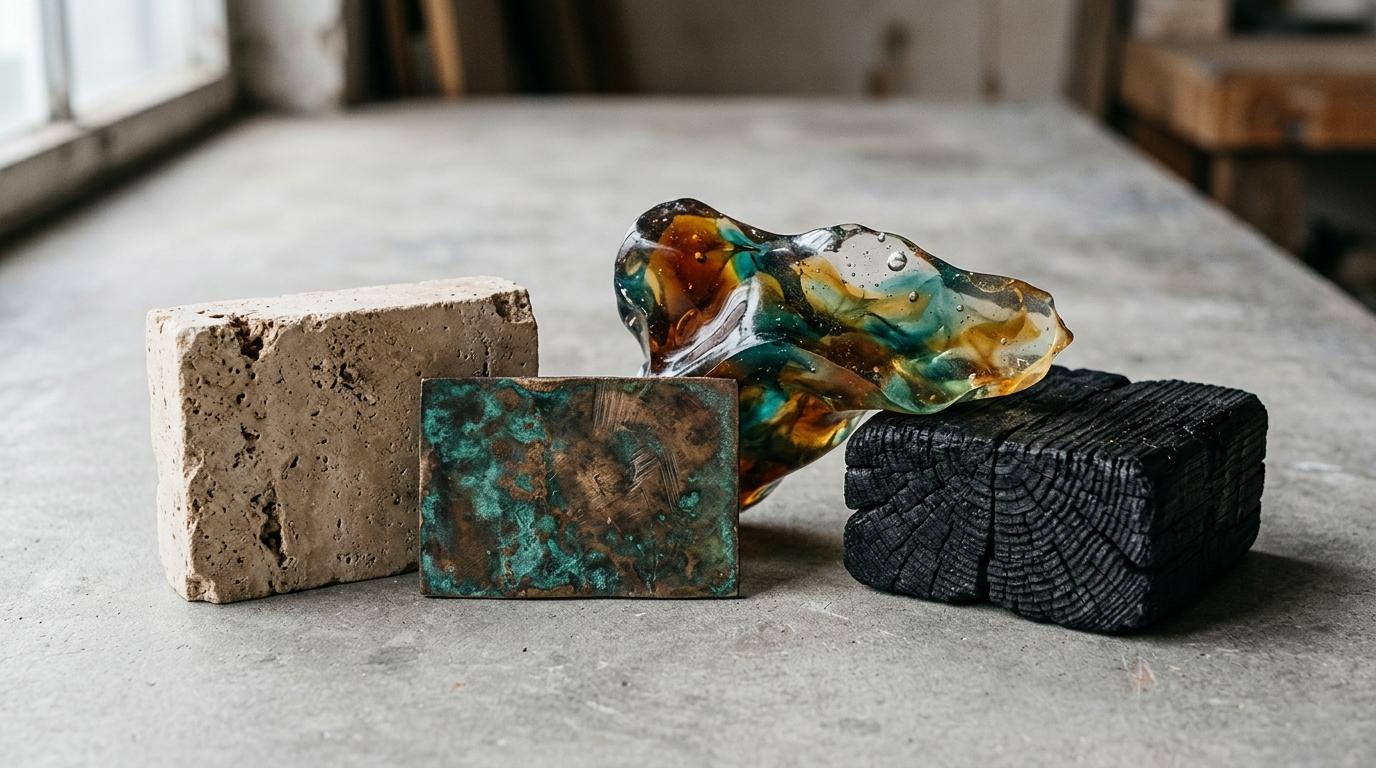
In collectible design, the material is the creative decision. Stone, metal, resin, wood: each one determines form, aging, texture, and what a piece will be worth decades from now. Industrial furniture picks materials for cost and efficiency. Here, a designer chooses travertine over marble, bronze over brass, charred oak over walnut, and that single choice shapes everything. Collectors and interior designers who understand these differences make sharper acquisitions.
Key points
- Stone grounds a space with weight and geological time. Travertine alone represents a $3.5 billion global market, driven by demand in luxury interiors.
- Bronze holds detail no other metal can match, and it gains character through natural patina over decades.
- Resin and jesmonite open formal possibilities (translucency, embedded color, impossible curves) that natural materials cannot reach.
- Wood remains the most versatile collectible medium. Techniques like yakisugi push it into contemporary sculptural territory.
- Material choice shapes how a piece ages, what it weighs, how it catches light, and what it will be worth in thirty years. It is never a decorative afterthought.
What makes stone the defining material of contemporary collectible design?
Stone dominates collectible furniture right now because it carries geological time in its surface. Travertine, marble, onyx, alabaster, and volcanic basalt are appearing not as luxury veneers but as sculptural media, carved and stacked and left deliberately unfinished.
According to Market Research Future, the global travertine market was valued at $3.553 billion in 2024 and is projected to reach $5.155 billion by 2035, reflecting a steady CAGR of 3.44%. The growth is driven partly by rediscovery of 1970s Italian design, but contemporary designers have pushed travertine far beyond retro references.
"It's not as sumptuous as marble, which would be a little bit too flashy for me," said Rick Owens, fashion and furniture designer known for his travertine-clad residences in Paris and Venice (10 Magazine, 2021).
Travertine's warm, porous surface and honeyed tones made it the breakout material of the past five years. Its natural pitting (the small cavities formed by mineral springs) gives each slab a texture that polished marble cannot replicate. Faye Toogood works with Purbeck limestone in a similar register, treating geological imperfection as a design element rather than a flaw.
"Materials are never neutral. They carry memory, resistance, and presence," said Vincenzo De Cotiis, Milan-based architect and collectible designer (b. 1958, Politecnico di Milano), represented by Carpenters Workshop Gallery (Whitewall, 2025).
Marble remains the premier luxury stone. The best collectible designers select their marble blocks personally, choosing specific pieces for color, veining, and character. The result is a work curated at the material level before any design begins.
On the practical side: stone furniture is heavy. That limits repositioning but reinforces permanence. Most stone surfaces benefit from sealing to prevent staining, and lighter marbles need care around acidic substances. A properly maintained stone piece will outlast every other object in a room.
Why do collectible designers choose bronze over other metals?
Bronze holds detail that other metals cannot match, and it improves with age. Cast bronze pieces reference centuries of sculptural tradition. The same lost-wax techniques used for Renaissance statuary now produce dining tables and lighting.
In 2025, a bronze piece by Francois-Xavier Lalanne sold for $16.4 million at Sotheby's New York, more than triple its $5 million pre-sale estimate (Artsy, 2025).
"The material world demands thoughtfulness and conscientiousness," said Max Lamb, British designer known for the Bronze Poly Chair (2008, lost-polystyrene casting technique), represented by Gallery Fumi (Eames Institute / Kazam! Magazine).
Bronze develops a patina over time that many collectors consider an enhancement. The surface oxidizes, darkening and gaining complexity in response to its environment. Designers and foundries specify particular patina finishes (verde, brown, black) as integral to the work's intended appearance. A bronze table at twenty years carries a depth of surface that a new piece simply does not have.
Brass offers warmth and luminosity. In contemporary design, unlacquered brass is often specified for structural elements (legs, frames, hardware) precisely because it will oxidize. That darker surface is part of the finished work, not a defect.
Steel, especially patinated or blackened, provides an industrial counterpoint. Its strength-to-weight ratio allows forms impossible in stone or wood: cantilevered surfaces, impossibly thin profiles, dramatic spans. Aluminum and stainless steel appear in more technologically oriented work, often combined with digital fabrication.
When assessing metal furniture, examine the join quality, the finish specification, and whether the patina is natural or applied. The best metalwork in collectible design rivals fine jewelry in its precision.
What can resin and jesmonite achieve that natural materials cannot?
Resin opens territories that stone, metal, and wood cannot reach. Translucency, embedded color, impossible curvatures, gradient effects. These formal possibilities have made resin a primary medium for designers working where furniture meets sculpture.
According to Fairfield Market Research, the global resin furniture market was valued at $20.93 billion in 2023 and is projected to reach $31.47 billion by 2032 (CAGR 4.85%). This figure covers all resin furniture including mass-market production; the collectible segment is a fraction, but its growth outpaces the broader market.
"Resin is an amazing material to manipulate. It can be completely transparent, completely opaque, polished, reflective, matte... I still haven't found its limits. The reason I'm a designer is to find those," said Sabine Marcelis, Dutch-New Zealand designer based in Rotterdam, known for cast resin and light-transmitting furniture (Dezeen, 2024).
Epoxy and polyester resins can be cast into molds, layered, or poured to create solid forms with inner depth and luminosity. When backlit, resin furniture glows. That quality explains its popularity in both collectible and hospitality contexts.
Jesmonite, a composite of gypsum and acrylic, has emerged as a more sustainable alternative. It offers similar versatility with a lower environmental footprint, producing no volatile organic compounds during curing. It can be pigmented, marbled, or finished to resemble natural stone. Several collectible designers have adopted jesmonite for its ecological credentials.
Durability varies by formulation. High-quality resin pieces resist scratching, moisture, and UV degradation. Lower-quality formulations yellow or crack within a few years. Always ask about the specific resin system used.
How are contemporary designers reinventing wood as a collectible medium?
Wood is the most familiar furniture material. That makes it the easiest to appreciate and the hardest to use in a way that feels new. Collectible designers who work in wood approach it with unusual techniques or at unusual scales.
According to worldmetrics.org, citing multiple industry surveys, nearly 80% of design professionals indicate that sustainable design is becoming more important to their practice. Wood, as a renewable material, sits at the center of that shift.
Yakisugi (known in the West as shou sugi ban) is a Japanese charring technique that produces surfaces of deep black with a subtle texture. The carbonized outer layer resists rot, insects, and moisture without chemical treatment. The term "shou sugi ban" is a Western approximation; the original Japanese practice, developed for exterior cladding, has been adapted by European and American designers for furniture that is contemporary in shape.
Monumental carving, working from a single log or block, creates furniture with a presence that assembled wood cannot match. The grain runs continuously through the piece, producing a visual coherence that reinforces the sense of a unified object.
Lamination and steam-bending allow curves that solid wood cannot achieve. Scandinavian designers refined these techniques in the twentieth century. Contemporary makers continue to evolve them, combining traditional craft with digital design tools.
For collectors, the key questions with wood furniture are species, source, and finish. Responsibly sourced hardwoods, finished with natural oils rather than synthetic lacquers, age most gracefully and carry the strongest sustainability credentials.
How do you choose the right material for your space and collection?
Material choice should reflect both the physical context and the emotional intention of a space. Each material family behaves differently with light, weight, aging, and maintenance. This goes beyond taste.
According to Imperial Stone Group, the global natural stone market reached $42 billion in 2024, driven by demand in luxury interiors and furniture sectors.
Stone grounds a room with gravity and permanence. It is the natural choice for dining tables, consoles, and coffee tables in spaces built for gathering. The weight is part of the proposition: a travertine dining table does not move. It is there.
Metal introduces dynamism and precision. Bronze and brass work well for lighting, shelving, and sculptural accent pieces, objects that catch light and change appearance through the day. Steel provides architectural structure where visual lightness is needed despite physical load.
Resin brings drama and translucency, making it effective in transitional spaces: lobbies, corridors, entrance halls. Its ability to transmit and manipulate light gives it a presence that shifts with natural and artificial illumination.
Wood provides warmth and organic texture, balancing the harder edges of architectural spaces. In a room of concrete and glass, a single piece of charred oak or walnut can change the entire atmosphere.
Good interiors combine materials with intention. Warmth against coldness, weight against lightness, opacity against translucency. Understanding how materials talk to each other is essential for any collector building a coherent environment.
Frequently Asked Questions
What is the most durable material for collectible furniture?
Stone, particularly travertine, granite, and basalt, offers the highest durability among collectible design materials. A sealed travertine table will outlast every other object in a room. Bronze follows closely: it does not degrade, and its patina adds character over decades. High-quality cast resin resists scratching, moisture, and UV, though lower formulations can yellow. Hardwoods finished with natural oils age gracefully but require periodic maintenance.
Does travertine furniture stain or scratch?
Travertine is porous and can absorb liquids if left unsealed. Most collectible-grade travertine furniture is sealed at the atelier, which prevents staining under normal use. Acidic substances (wine, citrus, certain cleaners) pose the greatest risk to lighter stones. Scratches are rare given travertine's density, and its natural pitting means minor surface marks blend into the existing texture rather than stand out.
Why does bronze develop a patina, and is it a defect or a feature?
Patina is a surface oxidation that occurs when bronze reacts with air and moisture. In collectible design, it is a feature. The patina darkens and enriches the surface over years, giving each piece a unique character tied to its environment and use. Designers and foundries specify particular patina finishes as integral to the work's intended appearance.
What is jesmonite and why do designers use it?
Jesmonite is a composite of gypsum and acrylic resin developed as an alternative to traditional casting materials. Designers use it because it offers versatility similar to epoxy resin (complex forms, embedded color, varied textures) with a lower environmental footprint. It produces no volatile organic compounds during curing and can be pigmented, marbled, or finished to resemble stone.
How do I tell high-quality resin furniture from low-quality?
Ask about the resin system. High-quality collectible resin pieces use UV-stabilized formulations that resist yellowing and cracking. Check edge clarity and surface consistency: premium casting produces no bubbles, uniform translucency, and crisp color gradients. Low-quality resin yellows within two to three years, shows micro-cracks under stress, and feels lighter than expected for its volume.
What is shou sugi ban and why is it used in collectible design?
Shou sugi ban is the Westernized term for yakisugi, a Japanese technique of charring wood surfaces with controlled flame. The process carbonizes the outer layer, creating a deep black finish with subtle texture that protects against rot, insects, and moisture without chemical treatment. Contemporary designers apply yakisugi to furniture forms that are modern in shape but carry centuries of craft knowledge in their finish.